
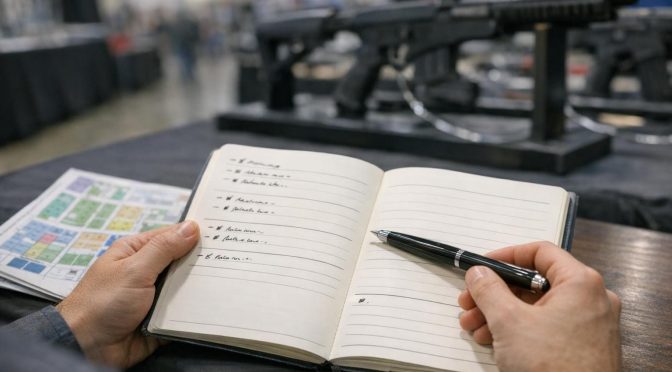
Even the most deliberate shopper can be driven to chaos by the sheer mass of a crowded firearms event. And don't even get started on returning to a table to double-check a specific firearm's price or the particulars of its accessory kit. Write down your memories of what you saw at each table. That's all you need. And, importantly, note the legal and business facts about each firearm that you decide to buy.
Set up a note system before entering
Choose the method you prefer prior to heading off to the event and start note taking there. A small notebook is ideal for quick note comparisons and doesn't take up space whilst in your pocket. Note taking on your phone can be search engine friendly but requires to be charged, unlocked and possibly held whilst at a gun display. Take your pick as long as it is quick enough.
You simply make an entry for each table/seller you examine to remind yourself later of what you saw. This can be as simple as "C Ct 50 3G Firearms", the aisle and table # where you found the guy. Make sure to spell the exhibitor's name exactly as you found it. "The blue table near the entrance" may mean nothing to you a few hours later.
You will also want to leave a few lines between entries in case you return to a specific seller with more questions, discover more model numbers for that same seller, or discover that an item that was included actually belongs with another gun that you had written down previously.
Record details that support a decision
These deciding firearm buying notes need to have enough information for later reference. Write down exact make and model, conditions of new or used items, and all prices and included accessories. Note any obvious wear and tear, and clearly state any missing parts. Avoid including any negative comments. Just plain facts!
Questions deserve their own line. Useful examples include:
– What is included in the stated price?
– What is included in the stated price?
– Are there return, transfer, shipping, or service conditions to understand?
– What additional costs will there be on top of the price for the items that were shown?
– What information should be verified before completing the transaction?
Do not recreate the label in full. Instead create entries that outline the key features of the firearms and how they differ from other models of similar design found at your venue. If necessary, write down the feature that differentiates a particular seller's model from other similar models. Put unknowns down as questions.
Keep exhibitors and products connected
Tracking exhibitors is often the largest part of setting up to take notes at a show. By indenting products under a seller's name for instance, or by using a consistent code for each entry, you can set up a system that works for you to keep track of who you got what from. Use the first letter of the exhibitor's last name and a number (e.g. 'AB-1', 'AB-2', 'AC-1', etc.).
There is often permission to take photographs of the equipment at display. Take photographs of any labeled items and write the corresponding code in your notes straight away. A full gallery of photographs of cases, gun safes, rifle stands, shooting displays etc will not fit on your phone.
By writing down the table location of any products of interest twice (i.e. when you first see them and then again later) the seller can be asked to confirm a model number or name of a product whose labels are mounted at very small letters. This will take only a moment to correct at the event location, rather than risking a previously written detail to be incorrect at home.
Use a short checklist for second looks
A first pass through your needs is better to gather possibilities than to make you buy something on the spot. Mark your first entries with 'investigate', 'compare' or 'pass' and then go through them later again to see if you still need to look into something or if you have forgotten something.
When you re-inspect a product, check if your earlier notes enabled you to answer all the relevant questions to make a decision about buying the product. If not, ask the seller for the information you require before agreeing a purchase price. Ensure you compare like with like (e.g. similar condition, same included components etc.) and note the total cost of purchase (including any additional costs). A product that appears to cost less than an alternative may not form part of the same package.
Don't test out how to use an item in note form and then lose it or poorly implement it at the event. Note what the seller permits and rigorously follow it. Even more, handle items in a manner you'd have a happy seller approve of if he or she happened to be walking by.
A useful checklist can include:
– Exhibitor name and table reference
– Exact item identification
– Condition and included components
– Price and unresolved cost questions
– Questions about transfer or other transaction steps
– Follow-up needed before purchase
– Your final status: investigate, compare, or pass
Separate purchase notes from legal verification
These requirements may change over time and even be jurisdiction specific so ensure you get the most up-to-date information from the licensed parties or from the event staff conducting the transaction. Do not rely on a seller's statement, your own previous experience, or a note from another event. Treat all purchase decisions with extreme caution and record all of your verification steps.
Ensure that all your legal notes and questions are distinctly separated from the product notes. Write heading notes as "verify before purchase" to remind yourself to verify answers. Record who you got the information from and the date you got it and what you still need to verify.
Applying the same discipline to financial matters, e.g., to how much one is willing to spend, and including all costs one anticipates to incur, will help in avoiding errors such as buying something because one felt pressured into an immediate decision due to it being promoted as being available only for a limited time by the seller.
Review the page before leaving
As you review your notes for any purchases that you have considered, take the time to review the photographs that you have taken, ensure all promising items have had their exhibits identified, and have you dealt with all of the questions pertaining to that item. Further cross reference any items that you have no intention of purchasing and discard the corresponding pages.
Home – Rewrite useful information into a simple comparison list and retain original notes until satisfactory confirmation of model names, conditions, costs and terms and conditions have been established. This simple process translates an event into a manageable decision making process.